I love dry beans. Now, I haven’t always loved them – I didn’t grow up eating them, except in the occational chilli, so it took me a while to come around. But I’m glad I finally did.
First, dry beans are healthy. High in protein and fiber and sorts of good stuff. Second, they’re versatile and good in tons of different dishes. But thirdly: they’re beautiful, and as a legume, they fix nitrogen.
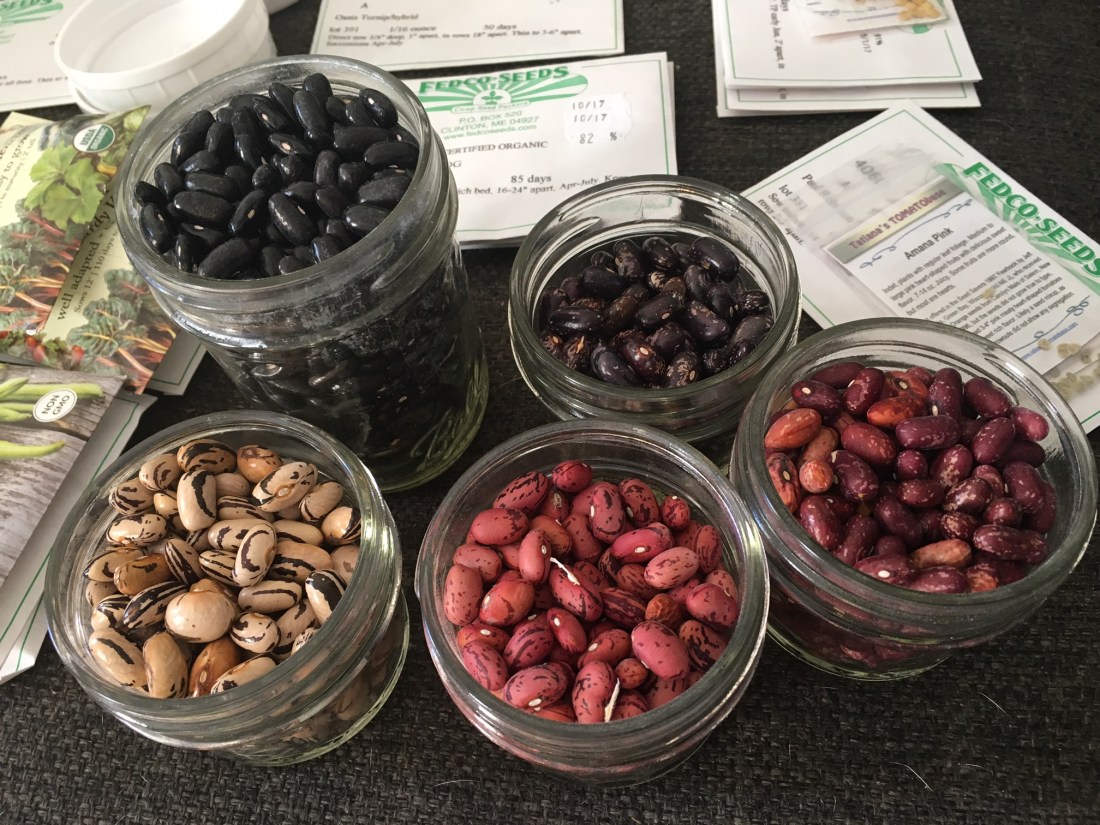
In my garden last year, I planted roughly 10′ of dry beans. I had no idea what yeild I was going to get, but I wanted to increase my seed bank for additional planting in following years. I only hand a few seeds of some varieties. Well, the yield surprised me — I got several large mason jars full (nearly 3 quarts), enough not only to expand my planting area next year, but to actually eat some this year.
Cherokee Trail of Tears (the black bean in the photo above) had by far the best production, despite being the smallest bean.
The other beans in the photo are Kosovo Bush Bean (a name I was told, but I believe this may actually be Ojo De Cabra / Eye of the Goat Bean), which is the white and brown bean. This one was a large bean, and I only had enough seed to grow a few plants. So even though I only got half a cup or so, that’s a decent enough yield for me. I’ll be able to grow a lot more this season, hopefully enough to actually eat.
The other 3 colors are all from Vermont Cranberry seeds. The bottom-most pink-hued seed is perhaps closest to what I think of as Vermont Cranberry, but the right-most, slightly darker hue is also close. The top color almost certainly got crossed with Cherokee Trail of Tears; it’s a dark purple, but with the stripes of VT Cranberry. Quite pretty all around, and I’ll be growing them out carefully this coming year to see if they produce true-to-color. I have just a few very light violet seeds that I’ll plant out as well.
In addition to the above, I’ll also be growing out Marfax dry beans, which are a golden tan color. All in all, I’ll be attempting a full 50′ bed of dry beans this year, in order to see what kind of yield I can get. I’ll be planting it in an area that could use a bit of nitrogen, too.
A bag of dry pinto beans may only cost a dollar or two at the grocery store, but dry beans are so satisfying to grow that I really don’t mind the trouble. My garden is so large, it’s actually kind of nice to have something to take up space. I think for most situations, where people have small raised beds or a limited garden area, higher value items like arugula, herbs, tomatoes, etc. would take precedence. But for me, it works.
I would be very pleased to see 10 quarts of dry beans from 50′ this year, should Mother Nature cooperate. Saving 2 quarts over for seed (which is probably overkill), would leave 8 quarts for eating. We’d probably only cook a pint at a time, every other week or so, which would be plenty to get us through the winter.
And, for the curious, here’s how I cook my beans:
Rinse the dry beans, careful to remove any leftover foreign matter (small stones, leaves, etc.), then place in a crockpot with enough water to cover the beans by 2-3 inches. Let soak overnight, or for a full day. Then change out the water, and turn crockpot on low for 6-8 hours, until the bean skin ‘cracks’ slightly when you blow on it. They should be soft and fully cooked through once that happens. Drain and use in whatever dishes you like! We use them in stir fry and burritos quite often. They’ll keep a full week in the fridge. Note, red kidney beans should be brought to a boil first; they have higher amounts of a naturally occuring toxin, ‘phytohaemagglutinin,’ which breaks down at high temperatures. Some are more sensitive to this toxin than others.

 Beane Hill Farm