For my first try at grafting apple trees, I’d say I didn’t do too shabby. Here’s the survival rate:
Dabinett: 1/3
Bramtot: 3/3
Kingston Black: 1/3
Yarlington Mill: 2/3
Redfield: 0/3
Golden Russet: 3/3
Keepsake: 2/3
Honeycrisp: 0/3
Esopus Spitzenburg: 2/3
William’s Pride: 3/3
And our “Beane Hill Pear”: 4/5
That makes 21 successful grafts out of 35 total attempts, and that’s good enough for me! (And leaves room for improvement!)
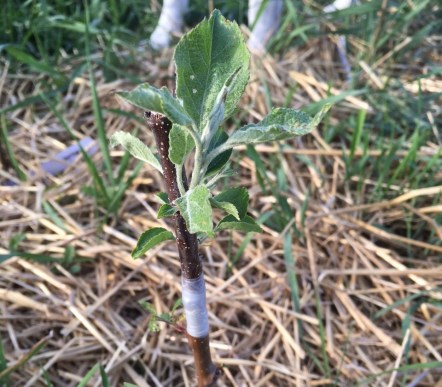
There may be one or two more survivors, but the above scions are definitely alive and growing. And although their grafts failed, all the rootstock (G.222, for the curious) is still alive, so I can simply try again next year with those.
Now, some notes!
Redfield (0/3) began leafing out while the graft was still waiting to be planted. Nice, plump buds… a little too big, I think. I planted these out in the garden back in April, and the cold weather hurt these buds especially hard, since they were breaking dormancy much too quickly. Nothing else was breaking dormancy at this point. This may be something with the variety, or it may be I had these in the warmest spot of all the grafts. Either way, it didn’t make it.
Honeycrisp (0/3) is a very popular apple, and a favorite of mine. So I was a little disappointed to see the poor quality of the scionwood when it arrived. Some other scions were thin, but this one took the cake. The size made it hard to work with, and I’m not surprised to see all the grafts fail on this one. (Fun fact, though: Keepsake is in its parentage, which is a great storage variety.)
William’s Pride (3/3) is growing like mad, and has started to flower. I’ve had to go through and pick off its little flower buds… although I really appreciate this guy’s enthusiasm!
Beane Hill Pear (4/5) is what I’ve dubbed the unknown variety on our property – very sweet, the sweetest pear I’ve ever had, in fact. We made perry with it last fall, and it has a little residual sweetness (pears have some unfermentable sugars). I think it would blend well with a couple wild pears we have along our woodlot. In any case, it is a pear worth saving. The parent tree has a gaping wound on the trunk, and a piece of rebar stuck through its middle (someone must have hoped it would keep the tree together!). The tree has apparently produced for many, many decades according to neighbors, and it’s still going strong judging by its canopy. But just in case, I wanted some backup. It’s too good a pear to lose.
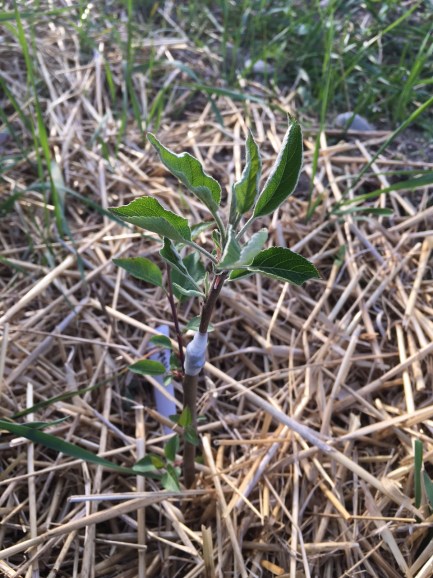
The rest of the failed grafts were probably a combination of my inexperience and the scionwood — like the Honeycrisp, I wasn’t impressed by some of the scionwood I received from my supplier. Next year, I’ll probably try another company, as long as I can find the varieties I’m looking for (apparently, Redfield & Honeycrisp!).
In a couple years, I should be able to take some scionwood off my own trees to graft! Now that’ll be full circle.
Leaving grafting for a moment, it seems like we have fewer blooms on our full-grown apple trees this year. Our pear trees haven’t bloomed at all. One lone apple tree bloomed like crazy, but that was it. Our other apples have put out a handful of flowers, but nothing spectacular. A local orchardist was saying they have fewer blooms this year as well, and no pears or peaches. We had some strange warm spells and sharp cool periods that are likely to blame.
As for the four trees we planted out last year, all are doing great! I’m especially pleased to see Old Pierre taking off so well. It looked a bit scraggly when we planted it, only a few leaves came out on the tips of its branches. Now it’s covered in nice healthy leaves. I expect if conditions are right next year, it would send out a few flowers – although it’ll be quite some time before we have enough fruit for cider-making!

 Beane Hill Farm